

Climate-Risk Assessment
CLIMATE CHANGE
Sunlight REIT is committed to strengthening its climate resilience through a proactive and strategic approach with respect to policy and governance, target setting and risk management.
Strategy
Scenario analysis
Climate-related scenarios outline potential future pathways, each characterized by varying levels of global warming and associated impacts. By modelling how different climate trajectories could influence our business operations, asset performance and strategic direction, we are better positioned to anticipate the challenges ahead. This scenario analysis helps us understand the financial implications of physical climate impacts, such as extreme weather events and changing environmental conditions, as well as transition risks stemming from the accelerating global transition toward a low-carbon economy.
Selection of scenarios
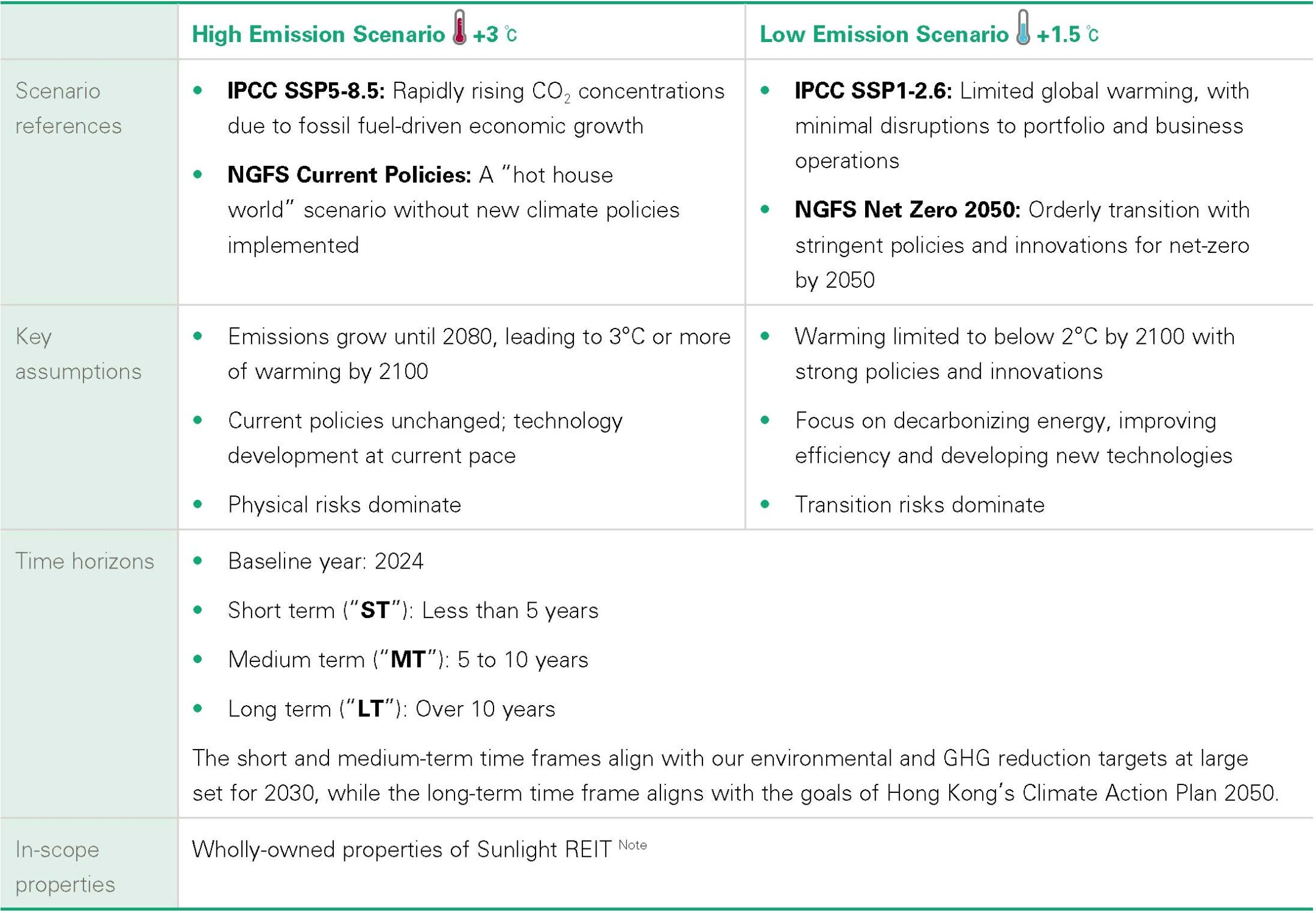
In our scenario analysis, we draw upon well-established frameworks from the Intergovernmental Panel on Climate Change (“IPCC”)1 and the Network for Greening the Financial System (“NGFS”)2 to evaluate physical and transition risks. We have selected specific scenarios from these frameworks and grouped them into two distinct pathways to assess potential business impacts:

The high emission scenario assumes limited climate action, leading to severe climate impacts and heightened physical risks.
The low emission scenario aligns with The Paris Agreement's goal of limiting global warming to 1.5°C above pre-industrial levels through immediate and ambitious emission reductions.
Notes:
- The IPCC is the international body tasked with assessing the science of climate change. There are five SSP-RCP scenarios, each with a different set of narrative assumptions and emissions trajectories.
- NGFS was established by eight central banks in 2017 and seven scenarios have been created to address physical and transition risks. These scenarios are frequently used by central banks and financial supervisors.
Note:
All properties of Sunlight REIT are located in Hong Kong.
Governance and Management of Climate-related Risks
Underpinned by a robust internal control system, business impact analysis procedures and a detailed contingency plan, we have in place a comprehensive risk management framework designed to safeguard our operations against risks and disruptions, as well as to ensure that we remain resilient in the face of unforeseen challenges.
For more information on our risk management framework, please refer to the “Risk Management” section in the “Corporate Governance Report” in Sunlight REIT’s 2025 Annual Report.
During the Year, based on the climate-related risk assessment and peer benchmarking, the ESG Committee has prioritized climate-related risks and opportunities that are considered most relevant to Sunlight REIT for scenario analysis, including two physical risks, one transition risk and one transition opportunity.
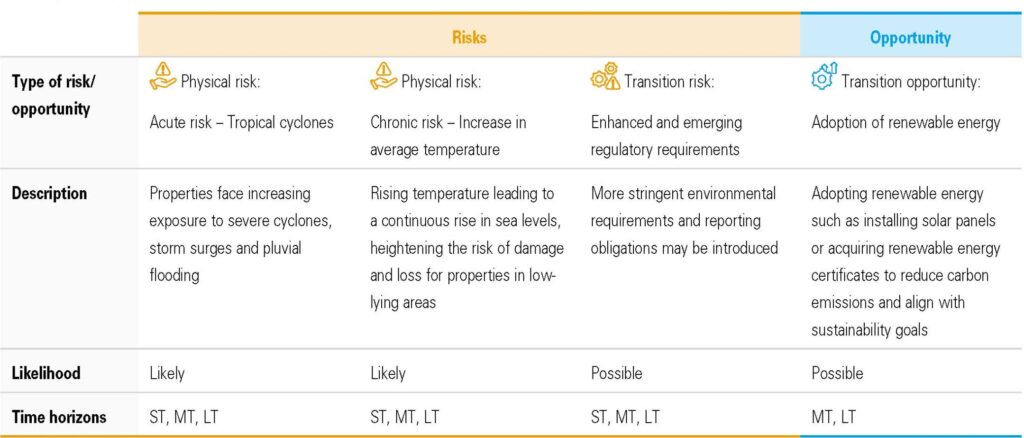
A range of mitigation strategies and initiatives has been implemented to address the aforementioned risks and capture the related opportunity. For more information on our mitigation strategies and initiatives, please refer to the section on “Climate Change and Carbon Emissions” in the 2025 Sustainability Report of Sunlight REIT.
Climate-risk assessment pursuant to SFC’s circular
In accordance with the SFC’s circular on the “Management and Disclosure of Climate-Related Risks by Fund Managers” dated 20 August 2021, the Manager is required to assess climate-related risks at least annually. Based on the ESG Committee’s recommendations, the Risk Taskforce considered that climate-related risks were relevant but not material to Sunlight REIT during the Year.